

When AI budgets balloon: what enterprises are learning in 2026
New research shows AI spend is growing faster than expected. Discover the drivers behind AI, and strategies to improve visibility and control.
Published on 22nd July 2026
AI was supposed to deliver efficiency. That was the promise that fuelled aggressive investments across enterprises over the past few years. But a growing body of evidence tells a different story—one that’s starting to feel familiar for IT leaders.
A recent article in Inc. highlights a stark reality: Many companies are seeing AI costs rise much faster than expected, with budgets expanding rather than shrinking. In fact, Gartner predicts worldwide spending will reach $2.52 trillion this year. And a KPMG survey finds that many organisations have shifted to a usage-based AI model, leaving many shocked at the cost of AI.
New research from the Flexera 2026 State of ITAM Report and the Flexera 2026 AI Pulse Report reinforces this trend, revealing that organisations are still struggling to gain visibility and control over AI-driven spending.
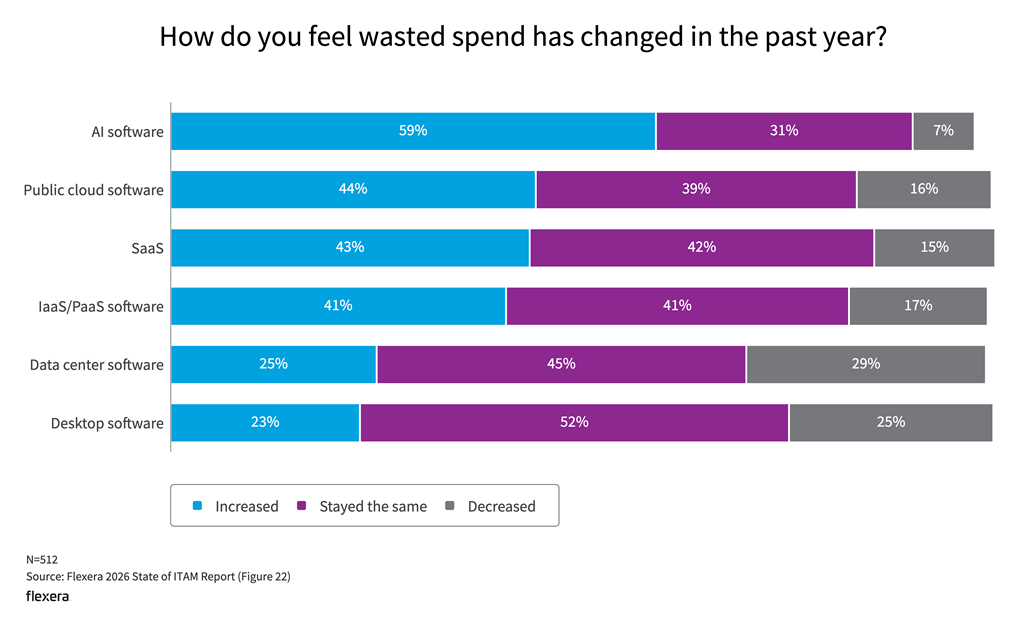
Taken together, these signals point to a clear conclusion: AI isn’t inherently cost-saving. Without disciplined management, it can quickly become one of the biggest drivers of IT spend.
The promise vs. reality of AI cost savings
For many organisations, the business case for AI seemed straightforward. Automating tasks, improving productivity and reducing manual effort should translate into lower costs.
The reality is more complex.
The Inc. article describes how enterprises are encountering unexpected expenses tied to AI—compute costs, data storage, model usage fees, integration work and the ongoing operational burden of deploying and scaling AI workloads. What’s especially notable is that these costs often increase as adoption grows, rather than stabilise.
In other words, success can actually make the problem worse. The more teams use AI, the more infrastructure, tokens and services they consume.
This aligns closely with what Flexera’s research has been surfacing: AI isn’t a one-time investment. It introduces an ongoing consumption model that behaves much more like cloud spending—dynamic, scalable and difficult to predict.
AI is following the cloud cost curve
If this all sounds familiar, it should. AI is effectively retracing the same path organisations experienced with cloud adoption. Early expectations of cost savings often gave way to unexpected overruns once usage scaled.
The same patterns are emerging
Across both Flexera reports, several consistent themes stand out:
- Consumption drives cost growth: AI usage tends to expand quickly across teams. As more business units experiment with models, tools and agents, consumption increases—and so do costs. What starts as a pilot can rapidly become an enterprise-wide expense
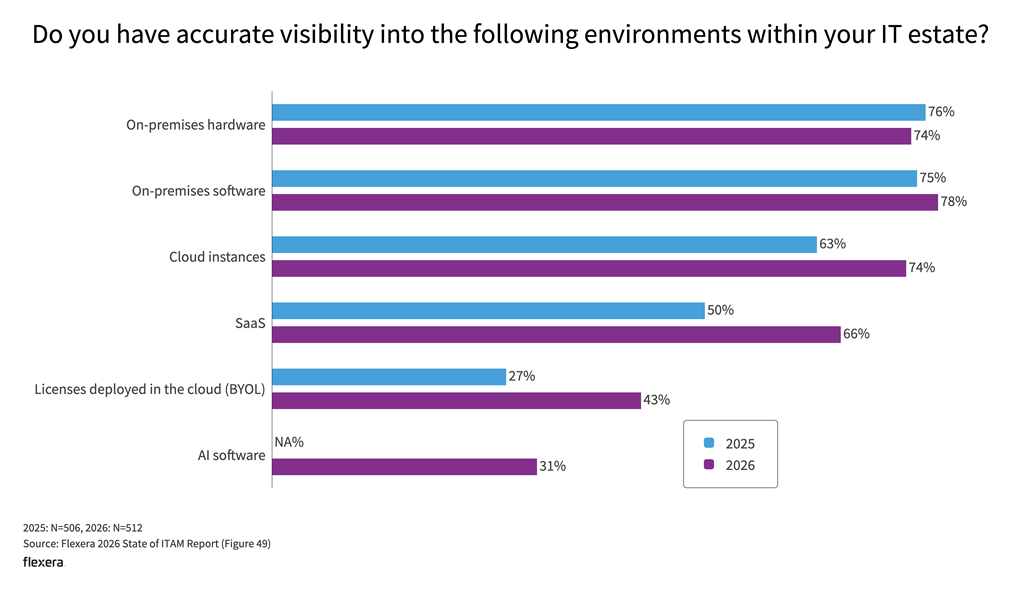
- Visibility is limited: Organisations still struggle to see where AI spend is happening. Shadow AI—tools and services adopted outside centralised IT—adds another layer of complexity. Without clear visibility, it becomes difficult to allocate costs or enforce accountability
- Pricing models are complex: Layered pricing models make forecasting and optimisation far more difficult than traditional software licensing.
- Optimisation lags behind adoption: Teams prioritise speed and experimentation over efficiency. As a result, organisations often scale AI workloads before they fully understand how to manage them cost-effectively. This delay creates a gap between adoption and governance
Why AI costs are harder to control
AI introduces a fundamentally different cost dynamic compared to traditional IT assets.
AI workloads span multiple layers, and each layer contributes to total cost, making it harder to identify where optimisation efforts will have the biggest impact. These layers include:
- Data pipelines
- Training and inference infrastructure
- Third-party APIs and services
- Integration into applications and workflows
Usage is unpredictable
Unlike fixed licenses, AI consumption fluctuates based on:
- User demand
- Model complexity
- Frequency of requests
- Data volume
This variability makes it difficult to set reliable budgets.
Efficiency gains don’t always translate to savings
AI can improve productivity, but that doesn’t automatically reduce spend. In many cases, efficiency gains lead to increased usage, which offsets or even exceeds the original savings. For example, a team that automates a process with AI may run that process more frequently or expand its scope—driving up consumption.
The hidden drivers of AI budget overruns
The KPMG report calls attention to several cost drivers that organisations often underestimate. Flexera’s research reinforces these insights with broader enterprise data.
- Infrastructure costs: AI workloads often require specialised infrastructure, including GPUs and high-performance computing environments. These resources come at a premium and can scale quickly with demand
- Data costs: AI depends on large volumes of data. Storage, processing and movement of that data can significantly increase overall spend
- Model usage and APIs: Many organisations rely on external AI services with usage-based pricing. As adoption grows, API calls and token consumption can become a major expense category
- Integration and operational overhead: Deploying AI into production environments requires ongoing engineering, monitoring and maintenance. These operational costs are easy to overlook during initial planning
What Flexera’s 2026 research adds to the picture
As AI adoption accelerates, a clearer picture is starting to emerge—one where rising costs, limited visibility and evolving governance challenges are shaping how organisations move from experimentation to long-term management.
AI spend is becoming a governance challenge
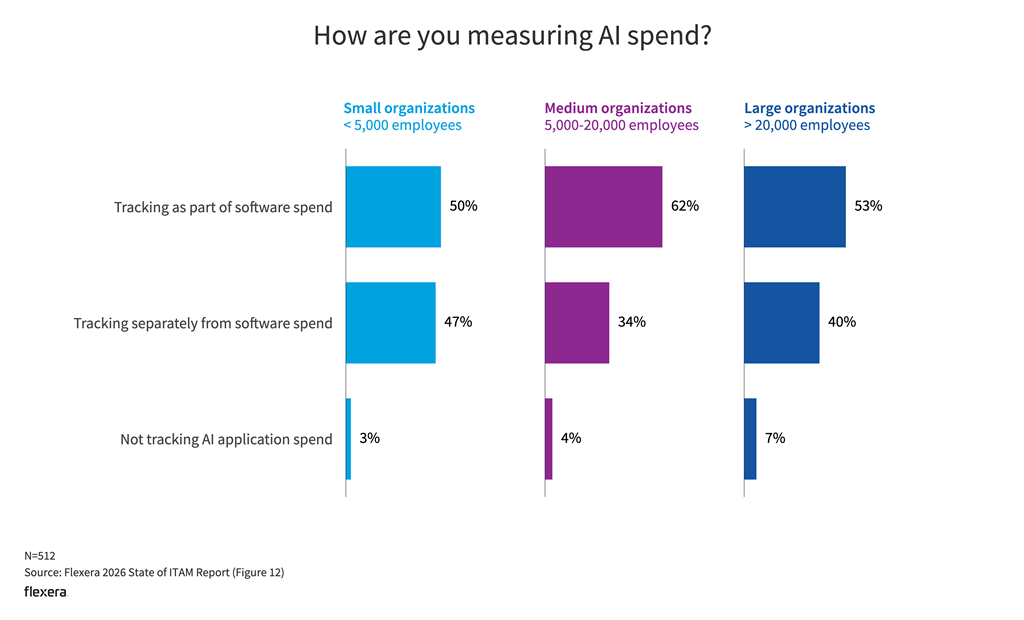
Organisations aren’t just dealing with higher costs; they’re struggling to manage them. AI spend often falls outside traditional IT asset management frameworks, creating gaps in tracking and accountability.
ITAM is evolving to include AI
The scope of IT asset management is expanding to cover, AI tools and services, consumption-based pricing models, and data and infrastructure dependencies. This evolution reflects a broader shift: AI is no longer experimental. It’s becoming a core part of the IT estate.
AI spend is becoming a governance challenge
Just as FinOps emerged to manage cloud costs, similar practices are now being applied to AI:
- Monitoring usage and spend
- Allocating costs to business units
- Identifying optimisation opportunities
However, many organisations are still early in this journey.
Moving from experimentation to discipline
Organisations need to transition from rapid AI adoption to disciplined AI management.
- Start with visibility: You can’t control what you can’t see. You need a clear view of where AI is being used, which teams are consuming resources and how costs are distributed across services. This requires integrating AI into existing asset and spend management frameworks
- Establish accountability: AI costs should be tied to specific teams or use cases. When business units understand the financial impact of their usage, they’re more likely to optimise
- Prioritise efficiency early: Optimisation shouldn’t be an afterthought. Consider model selection and sizing, usage patterns and frequency, as well as opportunities to reduce unnecessary consumption
- Treat AI as an ongoing investment: AI isn’t a one-time purchase. It’s an ongoing operational expense that requires continuous monitoring and adjustment
The bigger lesson: Innovation without governance is expensive
The excitement around AI is well deserved. It’s already transforming how organisations operate and compete. But the cost story is a reminder that innovation alone isn’t enough. Without governance, visibility and accountability, even the most promising technologies can become financial liabilities.
For enterprise leaders, the takeaway is simple but important: AI doesn’t reduce costs by default. It amplifies whatever systems you have in place—good or bad. Organisations that invest in strong management practices will be better positioned to capture AI’s value without letting budgets spiral out of control.
Broken into the piggy bank for some extra AI budget yet?
Don't let those costs spiral out of control unnecessarily - get the experts in to see how we can help rein in that spend.
Get in touchSource
Image Credit
Atlas Studio via Vecteezy