

Gartner says by 2020 “cloud shift” will affect more than $1 trillion in IT spending
Gartner says by 2020 “cloud shift” will affect more than $1 trillion in IT spending
"IT asset managers must identify risks and opportunities and adjust vendor management styles" says report.
Published on 21st November 2016
More than $1 trillion in IT spending will be directly or indirectly affected by the shift to cloud during the next five years, said Gartner, Inc. This will make cloud computing one of the most disruptive forces of IT spending since the early days of the digital age.
“Cloud-first strategies are the foundation for staying relevant in a fast-paced world,” said Ed Anderson, research vice president at Gartner. “The market for cloud services has grown to such an extent that it is now a notable percentage of total IT spending (see Table 1), helping to create a new generation of start-ups and “born in the cloud” providers.”
Figure 1: Shift From Traditional IT Spending to Cloud
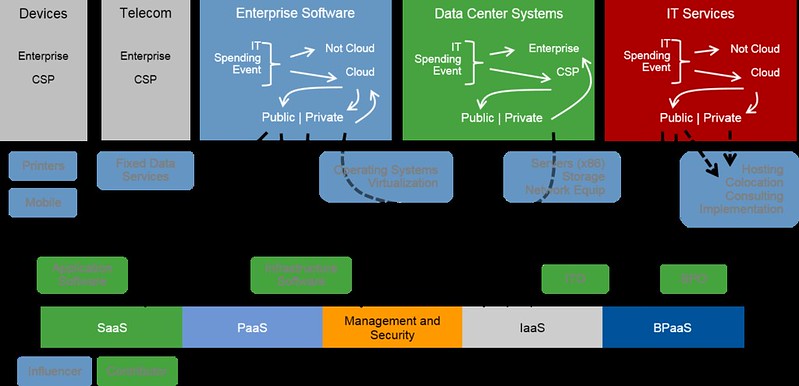
IT spending is steadily shifting from traditional IT offerings to cloud services (cloud shift). The aggregate amount of cloud shift in 2016 is estimated to reach $111 billion, increasing to $216 billion in 2020. Cloud shift rates are determined by comparing IT spending on cloud services with traditional non cloud services in the same market categories (see Table 1).
Table 1. Cloud Shift Summary by Market Segment
| Legacy Segment | Cloud Segment | Total Market Size in 2016 | Total Cloud Shift in 2016 | Cloud Shift Rate Through 2020 |
|---|---|---|---|---|
|
Business Process Outsourcing |
BPaaS |
$119 billion |
$42 billion |
43% |
|
Application Software |
SaaS |
$144 billion |
$36 billion |
37% |
|
Application Infrastructure Software |
PaaS |
$177 billion |
$11 billion |
10% |
|
System Infrastructure |
IaaS |
$294 billion |
$22 billion |
17% |
BPaaS = business process as a service; IaaS = infrastructure as a service; PaaS = platform as a service; SaaS = software as a service
In addition to the direct effects of cloud shift, many markets will be affected indirectly. Identifying indirect effects can help IT asset and purchasing managers ensure they are getting the best value out of new expenditure and are protected against risk, as well as assisting them to exploit the new opportunities caused by cloud shift.
For example, instead of buying operating systems (OSs) for each user in the traditional way, many will be provided as OS images — particularly with the use of containers for next-generation applications. Another example is that enterprise storage needs could be met with a lower up front cost and far more scalability by switching to cloud solutions instead of buying dedicated hardware.
“Cloud shift is not just about cloud. As organizations pursue a new IT architecture and operating philosophy, they become prepared for new opportunities in digital business, including next-generation IT solutions such as the Internet of Things,” said Mr. Anderson. “Furthermore, organizations embracing dynamic, cloud-based operating models position themselves better for cost optimization and increased competitiveness.”
More detailed analysis is available to Gartner clients in the report “Market Insight: Cloud Shift — The Transition of IT Spending from Traditional Systems to Cloud.”
Gartner IT Financial, Procurement & Asset Management Summits
Gartner analysts will provide additional analysis on IT financial and procurement trends at the Gartner IT Financial, Procurement & Asset Management Summits 2016 taking place September 12-13 in London and September 19-21 in Grapevine, Texas.