

3 FinOps trends to look out for in 2026
As it evolves beyond its traditional focus on cost reduction into a framework for driving business value, discover how FinOps is reshaping tech and finance strategies.
Published on 11th March 2026
FinOps bridges the gap between finance, engineering and operations teams to create a culture of accountability, transparency and shared responsibility for cloud costs. However, it has evolved from its traditional cost-reduction roots to providing greater value for all technology investments.
“Value is far more valuable as a metric than cost,” said Tim Crawford, founder and CIO strategic adviser of advisory firm AVOA.
FinOps continues to rise in popularity with 62% of IT leaders who increased their investment in FinOps services and/or platforms over the past 12 months, according to Flexera’s 2026 IT Priorities Report. As it grows, it also evolves.
“FinOps has expanded beyond cloud, or what many teams call ‘Cloud+,’ as organisations try to manage a wider set of technologies across public cloud, private cloud/on-prem and SaaS. Leaders want consistent practices that span the entire technology estate rather than isolated approaches for each environment,” said Jay Litkey, senior vice president of cloud and FinOps at Flexera.
And while it may seem like FinOps should be aligned under the CFO, it is predominantly managed by technology leadership, with 78% of practices reporting into the CTO/CIO organisation, up 18% compared to 2023 data, according to the State of FinOps 2026 Report by the FinOps Foundation. This means that FinOps isn’t just about financial reporting or cost optimisation — FinOps is a technology capability closely tied to architecture, engineering and platform decisions.
See how FinOps is driving value-based decision-making through hybrid and multi-cloud management, AI in FinOps practices and bringing developers into the spending conversation.
A holistic approach to managing hybrid and multi-cloud costs
Organisations increasingly operate in hybrid and multi-cloud environments. These deployment models introduce greater complexity, especially in managing cloud costs. Cloud visibility — the ability for IT teams to comprehensively monitor and analyse an organisation’s entire cloud infrastructure — is a must-have capability.
“FinOps teams are getting better at bringing traditional IT, cloud and asset management disciplines together. As environments grow more complex, organisations need shared visibility and common allocation practices that hold up across the entire stack,” said Litkey.
Organisations will need to rethink their cost management in these types of environments. Crawford calls for a holistic approach to managing value across the cloud providers, not just within each individual provider.
“FinOps provides organisations with a key business ability that has traditionally been missing in cloud environments: comparing multiple cloud and neo-cloud providers to each other in a comprehensive fashion and seeing how various workloads affect pricing in a holistic manner,” said Hyoun Park, vice president of telecom and mobility management at Calero.
It provides a more granular, nuanced way to compare cloud vendors and optimise based on the strengths each provider has across various areas, such as storage, compute, networking and compliance.
“This means that FinOps, which has to this date been very technical in practice, will start having a deeper financial component as FinOps starts being pulled more deeply into budgeting practices, cash flow and treasury planning, and other business planning processes,” said Park.
However, FinOps is moving away from being just a cost-reducing measure and increasingly towards how technology investments are planned, governed and valued, according to the State of FinOps 2026 Report.
“FinOps will be a core cloud operating discipline, not just a cost-optimisation exercise, as AI workloads introduce volatile, usage-based spend,” said Varun Raj, a cloud and AI engineering executive.
AI for FinOps
AI remains a widely adopted technology and can serve as a powerful asset when organisations use it with FinOps. It can also heavily influence cloud buying decisions by providing real-time cost insights and predictive analytics, paired with automated execution to make cost-effective choices.
It can empower line-of-business managers to interrogate cloud environments, invoices, alerts and requests, as well as ask deeper questions about the cloud and other IT costs that keep growing in their profit-and-loss responsibilities, according to Park.
“AI for FinOps is still developing. Today, it primarily helps teams interpret data and surface insights. The real transformation will come when AI can pair those insights with automated execution for rate and workload decisions to happen in real time,” said Litkey.
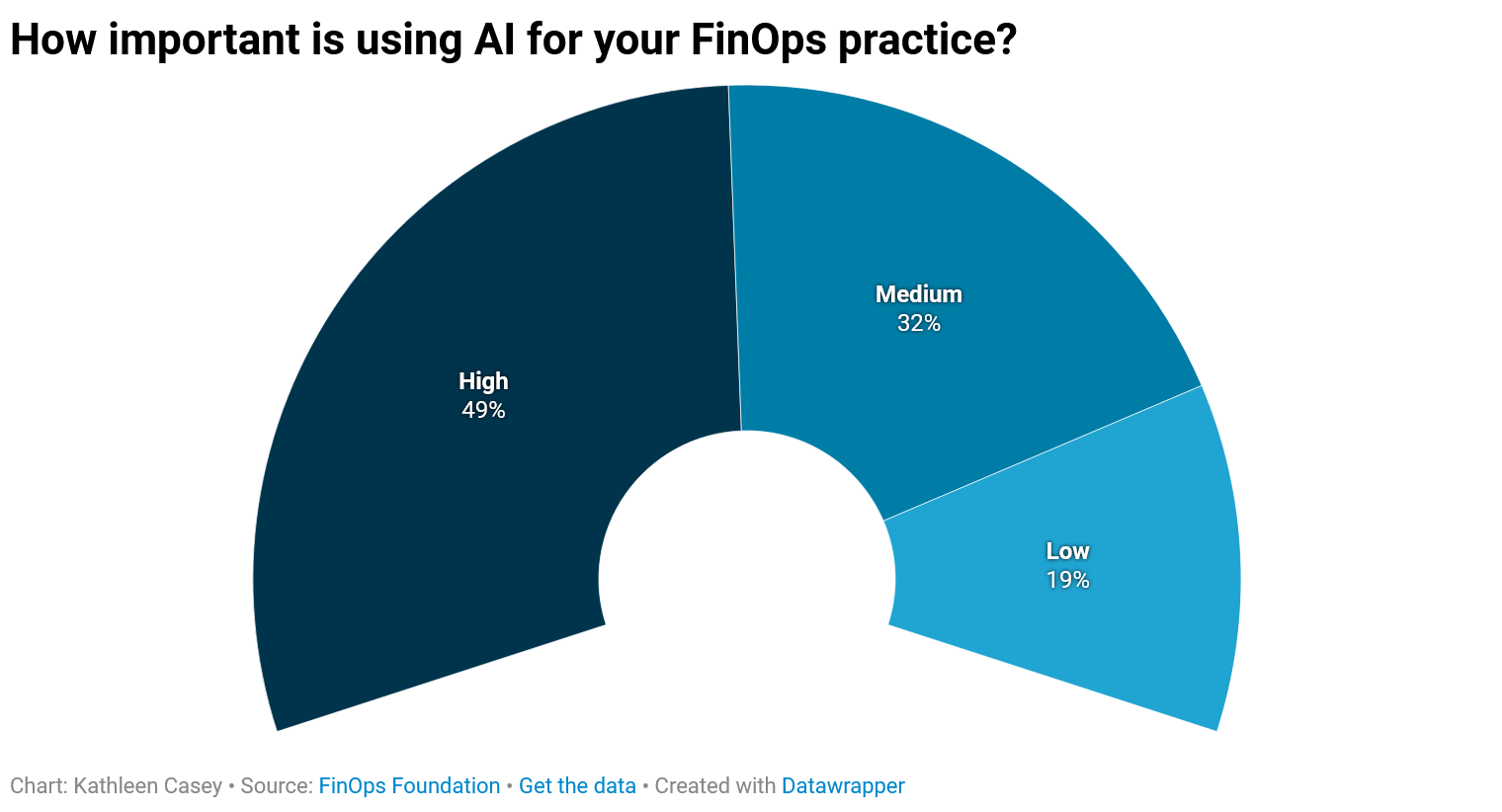
According to the FinOps Foundation, 49% of respondents said using AI for their FinOps practices is of high importance, with another 32% reporting medium importance.
Common uses for driving such responses include:
- Anomaly detection and faster alerting
- Automated right-sizing recommendations
- Natural language querying of cost data
- Automated discount instrument procurement
- Tagging resources to speed up allocation
“Understanding insights as to how to make operational changes, and potentially automate them, across cloud providers addresses the relationship between FinOps, technology business management, cost management and business outcomes. Due to the sheer amount of data and automation required, only AI presents the opportunity to achieve that panacea with speed and accuracy,” said Crawford.
As seen in these uses, automation remains a key part of a FinOps strategy.
“Automation is already reshaping cost management by helping teams act faster and more consistently. There are clear opportunities to automate tasks that do not affect workload performance, which frees up time for teams to focus on high-priority initiatives that require human judgement and decision-making,” said Litkey. “Organisations need automation to make a dent on cloud inefficiencies, which continues to grow with increasing cloud spend.”
The rise of the developer-facing FinOps
When IT people talk about FinOps, developers are not the first people who come to mind. However, they are becoming a more important voice when it comes to spending.
“[An] important trend is the shift toward developer-facing FinOps. More teams are integrating cost accountability into engineering workflows so they can address waste early in the development process,” said Litkey.
52% of engineering leaders say the disconnect between FinOps and developers is leading to wasted spend on cloud infrastructure costs, according to the FinOps in Focus 2025 report by Harness. Additionally, 62% of developers said they want more control over and responsibility for managing cloud costs.
With developer-facing FinOps, developers are made aware of the financial implications of their decisions, such as provisioning cloud resources, scaling applications or choosing specific services. Even more important is access to tools and dashboards to gain more visibility and monitor the costs associated with their workloads in real time.
However, too many tools can do more harm than good as complexity rises — especially in hybrid and multi-cloud environments. Litkey is seeing continued momentum in platform consolidation as teams look for fewer tools that can handle visibility and optimisation across rates and workloads.
Source
Image Credit
Toufick Ahamad Shawon via Vecteezy